
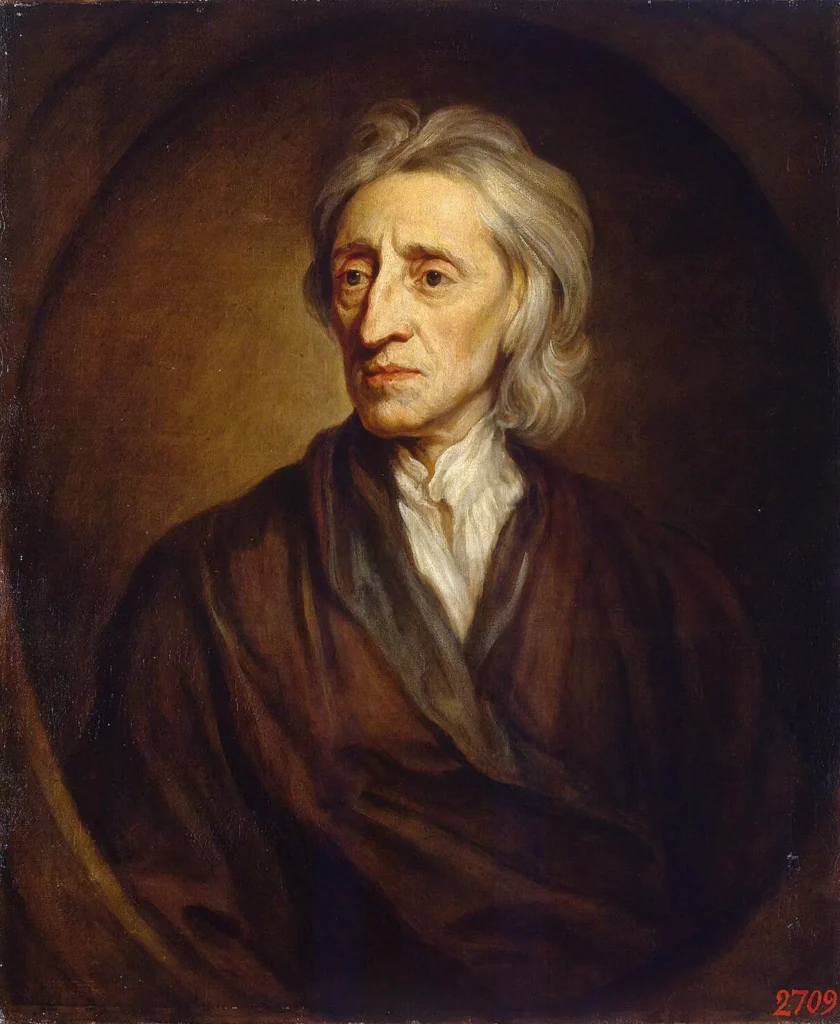


John Locke ( / l ɒ k / ; 29 August 1632 ( O.S. ) – 28 October 1704 ( O.S. )) [ 11 ] was an English philosopher and physician, widely regarded as one of the most influential of the Enlightenment thinkers and commonly known as the “father of liberalism “. [ 12 ] [ 13 ] [ 14 ] Locke lived through the tumultuous political era of the English Civil War and Commonwealth of England after the execution of Charles I, Restoration of the Stuart monarchy , and 1688 Glorious Revolution . These experiences affected his political thinking and life choices. During the Interregnum , Locke won a place at Christ Church, Oxford after attending the prestigious Westminster School. He spent 15 years at Oxford, first as a student, then as a tutor, pursuing medical and other scientific interests in a circle of friends. In 1666, Locke became an associate of Lord Shaftesbury , a key figure in English political life after the Restoration (1660), and Locke was appointed to governmental posts at Shaftesbury’s recommendation. Locke was elected a Fellow of the Royal Society (1668). When Shaftesbury fell from royal favor and died shortly thereafter, Locke went into exile for five years in the Netherlands (1683-85). He returned to England from exile, accompanying Queen Mary II in 1689. He published three of his most notable works soon after his return. He served as a Commissioner of Trade and Plantations , then retired from public life due to ill health. For the last years of his life, he lived in the household of Sir Francis Masham and his wife, philosopher Lady Masham , whom Locke had known since she was a young woman. Considered one of the first of the British empiricists , following the tradition of Francis Bacon , Locke is equally important to social contract theory. His work greatly affected the development of epistemology and political philosophy . [ 15 ] Important works include A Letter Concerning Toleration (1689), Two Treatises of Government (1689/90), and An Essay Concerning Human Understanding (1689/90). His writings influenced Voltaire , Jean-Jacques Rousseau , and many Scottish Enlightenment thinkers, as well as the American Revolutionaries . His contributions to classical republicanism and liberal theory are reflected in the United States Declaration of Independence . [ 16 ] Internationally, Locke’s political-legal principles continue to have a profound influence on the theory and practice of limited representative government and the protection of basic rights and freedoms under the rule of law. [ 17 ] Locke’s philosophy of mind is often cited as the origin of modern conceptions of personal identity and the psychology of self , figuring prominently in the work of later philosophers, such as Rousseau, David Hume , and Immanuel Kant . He postulated that, at birth, the mind is a blank slate, or tabula rasa . Contrary to Cartesian philosophy based on preexisting concepts, he maintained that we are born without innate ideas , and that knowledge is instead determined only by experience derived from sense perception , a concept now known as empiricism. [ 18 ] Locke is often credited for describing private property as a natural right , arguing that when a person—metaphorically— mixes their labour with nature , resources can be removed from the common state of nature . [ 19 ] [ 20 ] When Locke was born on 29 August 1632 to Puritan parents in the village of Wrington , Somerset, there was no hint that he would become a notable figure in history. His parents, John Locke, Sr. (born 1606), was 23 when he married Agnes Keene, age 33. They had their first child, John, about a year later, when the couple was living in a house that had been Agnes’s grandparents. The boy was baptized the same day as his birth in nearby All Saints’ Church. During the reign of Henry VIII , young Locke’s great-grandfather, Sir William Locke, was a prosperous merchant dealing in luxury cloth. His son Nicholas Locke (d. 1648) continued in the cloth trade, as a businessman involved in the putting out system, providing raw wool to weavers working in their homes, then collecting the finished cloth and sending it on. John Locke, Sr. was Nicholas’s oldest son, who became an attorney. Soon after Locke’s birth in 1632, the family moved to the market town of Pensford , about seven miles south of Bristol, into a house Nicholas gave his lawyer son. Young Locke grew up in a rural Tudor house in Belluton , where his brothers were born: Peter, who died in infancy, and Peter (b. 1637). Locke, Sr. served as clerk to the Justices of the Peace in Chew Magna . One of the justices was Alexander Popham , a Member of Parliament for Bath and a wealthy landowner. [ 21 ] [ 22 ] Young Locke was 10 at the outbreak of the English Civil War in 1642, pitting royalists supporting Charles I against Parliamentarian forces. It is no surprise that as a Puritan, Locke’s father fought in the Parliamentarian forces, the winning side of that conflict.
Source https://en.wikipedia.org/wiki/John_Locke