
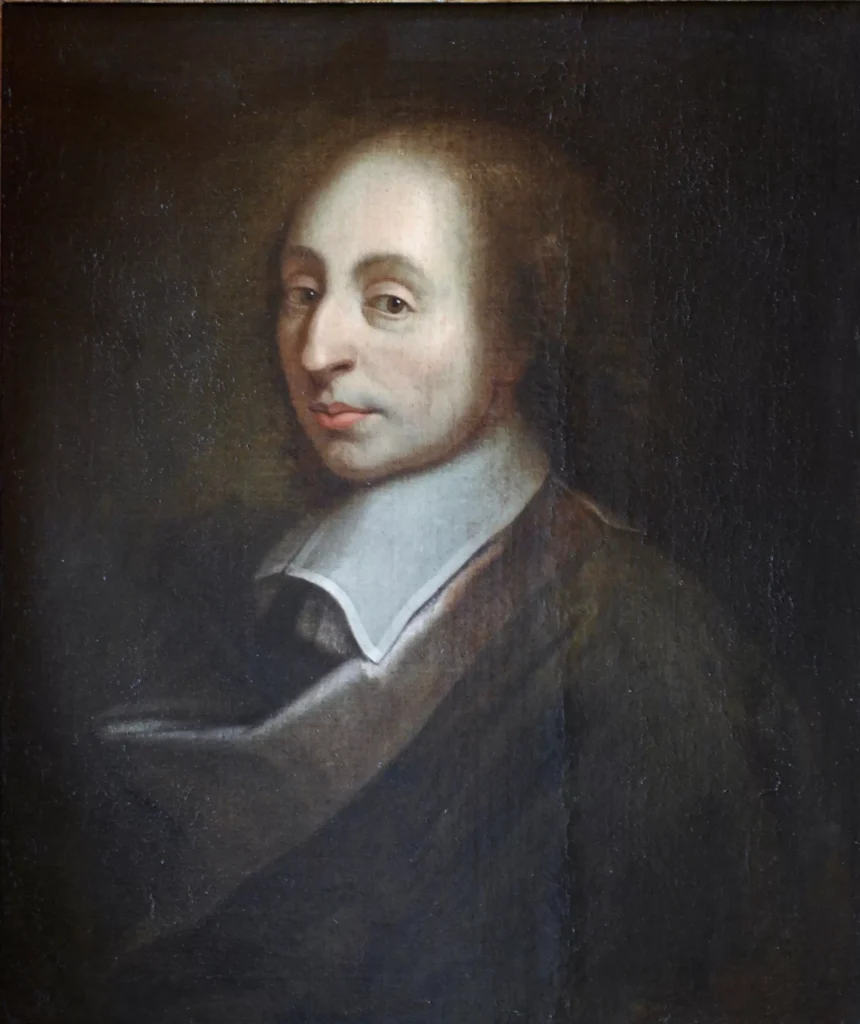


Blaise Pascal [ a ] (19 June 1623 – 19 August 1662) was a French mathematician , physicist , inventor, philosopher , and Catholic writer. Pascal was a child prodigy who was educated by his father Étienne Pascal , a tax collector in Rouen . His earliest mathematical work was on projective geometry ; he wrote a significant treatise on the subject of conic sections at the age of 16. He later corresponded with Pierre de Fermat on probability theory , strongly influencing the development of modern economics and social science . [ citation needed ] In 1642, he started some pioneering work on calculating machines (called Pascal’s calculators and later Pascalines), establishing him as one of the first two inventors of the mechanical calculator . [ 6 ] [ 7 ] Like his contemporary René Descartes , Pascal was also a pioneer in the natural and applied sciences. Pascal wrote in defense of the scientific method and produced several controversial results. [ clarification needed ] He made important contributions to the study of fluids , and clarified the concepts of pressure and vacuum by generalising the work of Evangelista Torricelli . The SI unit for pressure is named for Pascal . Following Torricelli and Galileo Galilei , in 1647 he rebutted the likes of Aristotle and Descartes who insisted that nature abhors a vacuum . He is also credited as the inventor of modern public transportation , having established the carrosses à cinq sols , the first modern public transport service, shortly before his death in 1662. [ 8 ] In 1646, he and his sister Jacqueline identified with the religious movement within Catholicism known by its detractors as Jansenism . [ 9 ] Following a religious experience in late 1654, he began writing influential works on philosophy and theology. His two most famous works date from this period: the Lettres provinciales and the Pensées , the former set in the conflict between Jansenists and Jesuits . The latter contains Pascal’s wager , known in the original as the Discourse on the Machine , [ 10 ] [ 11 ] a fideistic probabilistic argument for why one should believe in God. In that year, he also wrote an important treatise on the arithmetical triangle. Between 1658 and 1659, he wrote on the cycloid and its use in calculating the volume of solids. Following several years of illness, Pascal died in Paris at the age of 39. Pascal was born in Clermont-Ferrand , which is in France’s Auvergne region , by the Massif Central . He lost his mother, Antoinette Begon, at the age of three. [ 12 ] His father, Étienne Pascal , also an amateur mathematician, was a local judge and member of the ” Noblesse de Robe “. Pascal had two sisters, the younger Jacqueline and the elder Gilberte . In 1631, five years after the death of his wife, [ 13 ] Étienne Pascal moved with his children to Paris. The newly arrived family soon hired Louise Delfault, a maid who eventually became a key member of the family. [ citation needed ] Étienne, who never remarried, decided that he alone would educate his children. The young Pascal showed an extraordinary intellectual ability, with an amazing aptitude for mathematics and science. [ 14 ] Etienne had tried to keep his son from learning mathematics; but by the age of 12, Pascal had rediscovered, on his own, using charcoal on a tile floor, Euclid ’s first thirty-two geometric propositions, and was thus given a copy of Euclid’s Elements . [ 15 ] Particularly of interest to Pascal was a work of Desargues on conic sections . Following Desargues’ thinking, the 16-year-old Pascal produced, as a means of proof, a short treatise on what was called the Mystic Hexagram , Essai pour les coniques ( Essay on Conics ) and sent it — his first serious work of mathematics — to Père Mersenne in Paris; it is known still today as Pascal’s theorem . It states that if a hexagon is inscribed in a circle (or conic) then the three intersection points of opposite sides lie on a line (called the Pascal line). Pascal’s work was so precocious that René Descartes was convinced that Pascal’s father had written it. When assured by Mersenne that it was, indeed, the product of the son and not the father, Descartes dismissed it with a sniff [ editorialising ] : “I do not find it strange that he has offered demonstrations about conics more appropriate than those of the ancients,” adding, “but other matters related to this subject can be proposed that would scarcely occur to a 16-year-old child.” [ 16 ] In France at that time offices and positions could be—and were—bought and sold. In 1631, Étienne sold his position as second president of the Cour des Aides for 65,665 livres . [ 17 ] The money was invested in a government bond which provided, if not a lavish, then certainly a comfortable income which allowed the Pascal family to move to, and enjoy, Paris, but in 1638 Cardinal Richelieu , desperate for money to carry on the Thirty Years’ War , defaulted on the government’s bonds.
Source https://en.wikipedia.org/wiki/Blaise_Pascal